
Check the exact product, not a platform-wide claim
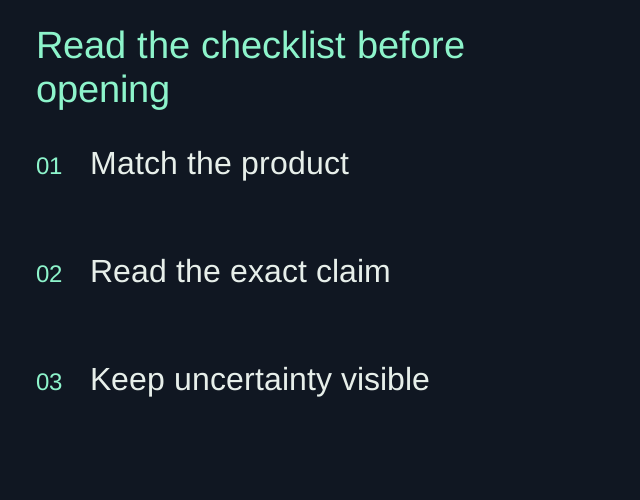
Two products on one platform can have different contents and allocation rules. Start with the specific pack or draw you are considering. Save its name, the date you read it and the relevant checklist or outcome page. Confirm whether the page is current, whether it describes remaining contents or an original collection, and which terms explain changes.
A homepage example is not necessarily a complete checklist. A gallery can mix previous outcomes, selected promotional images or editorial artwork. RipsFinder’s own illustrations are not an operator checklist and must never be used to infer a chance of receiving a particular card.
Read the distribution in both directions
Look for the range of outcomes rather than only the most attractive one. Determine whether probabilities apply to individual cards, groups, value bands or another category. A percentage shown beside a band does not automatically describe every card within it. If the disclosure uses a value range, ask how that value is defined and updated.
- Identify which possible outcomes are actually listed.
- Read the least valuable or least suitable outcomes as carefully as the highlights.
- Check whether the probabilities are for this product and this point in time.
- Find the policy for sold-out items, substitutions or changing contents.
- Ask what information is unavailable rather than filling it in yourself.
Do not turn incomplete information into a return estimate
A meaningful calculation requires the relevant probabilities and consistently defined outcomes. Missing probabilities, overlapping bands or unstable valuations can make a neat spreadsheet misleading. Even a correctly calculated average would not guarantee your result or the price at which you could sell the allocated item.
Keep three concepts separate: an outcome’s displayed value, an available offer for that exact item, and net proceeds after conditions or charges. There is no sound reason to substitute one for another merely to produce a percentage. This guide does not publish an expected-return figure or a minimum-value promise for any platform.
Fairness claims answer a narrower question
An operator may describe an outcome-verification method. Read what the method actually verifies, which inputs are available and whether you can reproduce the check. A method intended to show that an outcome was not changed after a commitment does not, by itself, prove attractive pricing, correct valuations, physical condition or eligibility for your country.
Similarly, a published checklist does not independently prove that every physical asset is available for delivery on the terms you expect. Outcome mechanics, custody and redemption still need their own evidence. RipsFinder records primary claims with limitations rather than treating one technical label as an all-purpose endorsement.
Make the decision before the animation
Set a spending limit that does not depend on selling the next outcome. Decide whether you would still want the product if you received an ordinary listed item. If your objective is an identified card rather than the experience, compare the alternative of researching a direct purchase. Avoid making another opening the automatic response to an unwanted result.
When a key disclosure is missing, keep a copy of your question and ask the operator for a current source. Do not assume that a video, a previous customer’s result or an affiliate’s highlighted card answers the question. A transparent unknown is more useful than a precise-looking unsupported number.