
Start with the question
Football collecting includes distinct products and formats. This guide concerns physical association-football cards, also called soccer cards. Album stickers, digital-game items and personalised novelty cards need to be identified separately.

Choose a small collecting goal
An exact goal makes the checklist useful. “One base card for each player in this team section” is a different project from “every parallel of my favourite player” or “one card showing a memorable season”.
Write the season and collection name next to the goal. A player can appear in multiple collections, designs and subsets in the same year. Choosing the player does not yet identify the card.
You do not need to begin with the most expensive version. Decide which documented items actually belong in your project before comparing prices or opening products.
Cards, stickers and digital items are different
Check the listing or package for its full product description. An album sticker is not automatically the trading card that appears in another collection. A digital-game player item does not establish a physical card entitlement.
“FIFA” can describe a physical licensed collection, but the word is also used in searches for video-game cards and custom designs. Conversely, physical club-football cards need not belong to a FIFA-branded collection. Match the competition, publisher, collection and season, not just the search term.
For example, the official German UEFA Club Competitions Knockout 2025/26 page links a specific physical collection to its checklist. That is a useful documentation route; it is not a recommendation to buy or a confirmation of delivery to every EU address.
Use a card identity record
| Field | What to record |
|---|---|
| Player and team | As described on this card, rather than assumed from a current squad |
| Season and competition | The exact collection's context |
| Publisher and collection | Full product name; include edition or language where relevant |
| Card or subset number | Copy it exactly, including letters or prefixes |
| Version | Base, named parallel, insert or another documented category |
| Serial stamp | The actual numerator/denominator, if present |
| Condition | Raw condition evidence or provider and full grade |
Keep a source link and photographs with the row. A player's transfer or a similar design in another release should not silently change your identification.
Understand the main card descriptions
These are collecting terms to resolve through the exact release documentation, not a universal ladder from cheap to expensive.
| Description | What to check |
|---|---|
| Base card | Its place in the collection's principal checklist |
| Parallel | The named variation of a card or subset; record colour, finish and numbering where documented |
| Insert | The separate design or theme and its own checklist identity |
| Autograph card | What the manufacturer states about the signature and any associated certification |
| Relic card | The exact description of the material; do not assume every relic is match-worn |
| Rookie designation | What the particular release identifies; do not infer the player's earliest-ever collectible from a badge alone |
Categories can overlap. An autograph card can have a numbered parallel. An insert can have its own variants. Keep the complete description rather than retaining only the most exciting word.
The manufacturer's UCC Knockout 2025/26 checklist provides a concrete example: it separates base, autograph and other sections, and notes that parallels and autographs can vary by subject. A player appearing somewhere in the document does not prove every possible variation exists for that player.
A card number is not a serial stamp
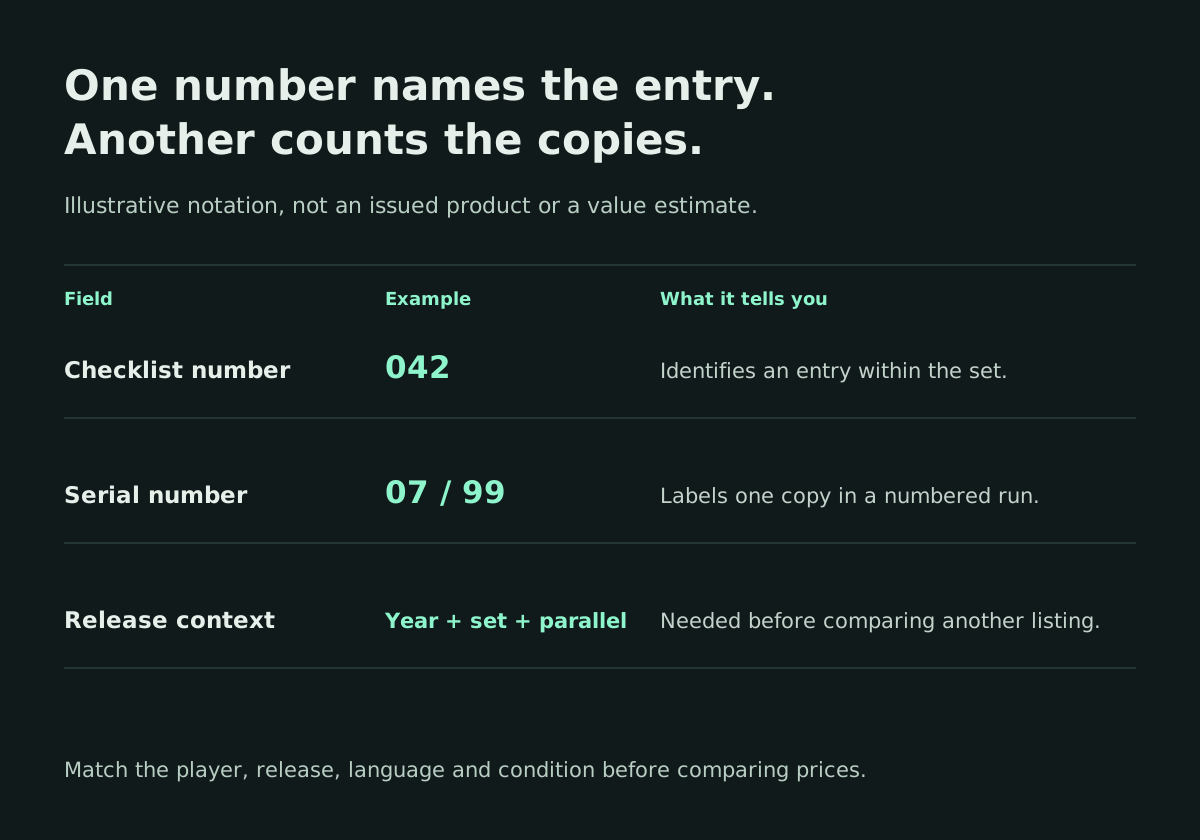
A card's number identifies an entry in the collection. A serial stamp can identify a numbered copy of a particular variant. They should be recorded in different fields.
In the illustration, #042 and 07/99 are entirely fictional. The first represents a checklist identifier. The second illustrates the sort of mark you would investigate against a manufacturer's numbered-variant description. Neither number describes a real football card in this guide.
For a documented real example, the UCC Knockout checklist labels its blue parallel /99 and orange parallel /25. Those descriptions apply to that release; the same colours do not carry universal limits across all football products.
A variant's stated numbering also does not give the total number of cards featuring the player, the total number of other versions or a chance of receiving it from a particular pack. Keep each of those questions separate.
Find a card without inventing its odds
Use the official collection page to reach the checklist, then locate the relevant section and exact player/card entry. Next, read any product-specific distribution notes for that version.
Record one of these conclusions:
- Listed in the checked collection and section.
- A named variant is documented, but the exact subject needs confirmation.
- Product-specific inclusion is stated for the exact format checked.
- The checked source does not resolve where this version is distributed.
Do not turn “listed” into “guaranteed in this box”, or transfer a statement from one box format to another. A third-party repack or live break has a separate allocation description. The official set checklist does not supply that seller's selection probabilities.
Compare the cost of the actual item
For an identified single, check photographs, condition, exact variant and the delivered price. For a sealed product, record the correct version, quantity, delivery and known additional charges without assuming the contents will complete your collection.
An EU reader may be viewing a seller outside the EU. Website language, currency and a European-looking domain do not establish the dispatch location or all charges. Confirm the actual route and destination terms, leaving unresolved amounts visible rather than supplying a universal tax rate.
If you choose a live break, check which cards your spot receives, how unmatched cards are treated and what shipping includes. Those rules are different from owning the whole sealed product.
Turn a wanted player into an exact wanted card
A variant claim should be matched to its own evidence. If a listing describes a numbered version, request a readable image of the actual stamp and compare the description with the relevant manufacturer record. Do not fill an unreadable numerator from the listing title or use a different player’s example to settle it. For an unnumbered item, leave the serial-stamp field blank rather than assigning it the limitation shown on another version.
Condition and delivered cost belong beside the identity, not in its place. Once two listings appear to describe the same card, record what each photograph shows, what remains unconfirmed and the complete known charges to your destination. A lower headline price cannot resolve a mismatched collection or an unclear condition record. Equally, an attractive image of an expensive variant does not require you to change a collecting goal that was originally limited to base cards.
Questions to settle before your first opening
A sealed product is a format choice rather than a completed wanted list. Before opening, write down whether the experience itself is part of your goal and which exact collection the product contains. If you need one identified item, compare that task separately with obtaining the item as a single. Neither route removes the need to check identity, condition and the terms of the actual transaction.
A useful first project can remain small. Start with a clearly defined team section, a player theme or a documented set segment, then mark owned, missing and unresolved entries. Keep cards outside that scope on a separate “interesting later” list. This gives an enjoyable discovery a place in your notes without allowing every new parallel, insert or unfamiliar abbreviation to become an immediate purchase requirement.
Follow-up questions
Is a checklist number the same as a serial stamp?
A checklist number identifies an entry. A serial stamp identifies a numbered copy of a documented variant; keep the two fields separate.
Should I begin with a player or a complete set?
Choose a goal you can define and budget for, then record its collection and season. Add optional discoveries to a separate list.
Keep your first project manageable
Make a short wanted list with the exact collection, card identity, acceptable condition and spending limit. Mark what you own, what is missing and what still needs verification. A binder gap does not require an immediate purchase, and an expensive parallel does not need to become part of the goal you originally chose.
Use the singles-versus-packs worksheet when deciding how to obtain a wanted item. If the opening format itself is unclear, the card-opening format guide explains the difference between a sealed purchase, a repack and a break spot.
Sources and evidence limits
Primary documentation checked on the dates below. A source check is not firsthand collecting, authentication, grading or transaction testing.
- de.topps.com: official German UEFA Club Competitions Knockout 2025/26 pageChecked 2026-11-14 · Exact documentation cited in the collector guide; bounded by its surrounding text.
Documentation research, not firsthand purchase/grading/authentication testing. No general odds or availability inferred.
- cdn.shopify.com: manufacturer's UCC Knockout 2025/26 checklistChecked 2026-11-14 · Exact documentation cited in the collector guide; bounded by its surrounding text.
Documentation research, not firsthand purchase/grading/authentication testing. No general odds or availability inferred.