
Start with the question
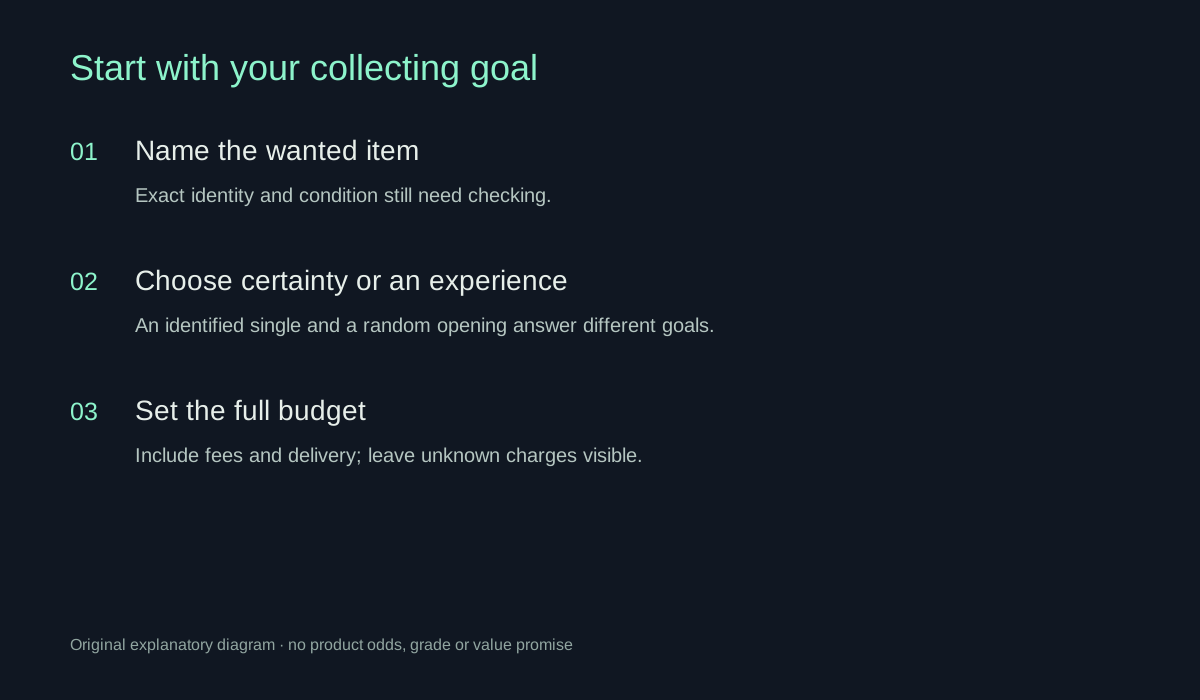
“I want this card” and “I want to open something” are both understandable goals. They need different spending decisions. A pack can provide an opening experience without providing the card you were hoping for.
What can you know before paying?
| Question | Buying an identified single | Opening a random pack |
|---|---|---|
| Can I select the exact card? | You select the item described in the listing | You select the product; its random contents remain unknown |
| Can I inspect the intended card's condition? | Ask for photographs and a specific condition description | The individual cards inside are not available for inspection before opening |
| Do I know the purchase price? | Record the item price and additional charges | Record pack price, quantity and additional charges |
| Does payment complete my collecting goal? | Only if the correct item arrives as agreed | Obtaining your target card is uncertain |
| Can I deduct future resale from the cost? | Record cash recovered only when funds are received and available; keep charges and holds separate | Unwanted cards are not cash recovered merely because you could offer them for sale |
Fixed-content products are another category. Manufacturer guidance distinguishes fixed decks from randomized boosters. Check the exact contents rather than assuming every package bearing the same artwork contains the same cards.
When you want a particular card
Make a short identity record before comparing listings:
- Set or series and collector number.
- Edition, printing, language and finish.
- Raw condition, or grading company and grade where applicable.
- Photographs of the actual item and any disclosed defects.
- Item price, delivery charge and other known costs.
Two listings with similar pictures may describe different printings or conditions. A condition label also needs a definition. Published condition guidance illustrates why corners, edges and surface damage deserve separate attention; one marketplace's labels are not a universal grading standard.
An identified card is not automatically authentic, correctly described or fairly priced. Ask for enough evidence to assess the item, and read the seller's documented delivery and return terms. A stock image does not show wear on the particular card being sold.
When opening is part of the goal
Opening can be something you choose to spend money on, rather than a method of obtaining a named card. Decide what that experience is worth to you without relying on selling the contents afterwards.
Write down the amount you are prepared to spend before starting. Include delivery and any other payable charges within that limit. Finishing the planned openings without the desired card does not create an obligation to buy another pack.
A pack count alone cannot tell you the chance of obtaining a target. That needs the relevant probability and a model that fits the product. Avoid filling a missing probability with a guess based on the number of cards in a checklist.
Put the complete cost on one sheet
Use one cost scope for both options. Comparing a delivered single with a pack subtotal leaves part of the decision unresolved.
| Field | Single-card option | Pack-opening option |
|---|---|---|
| Goal | Exact item wanted | Experience or collection goal |
| Item or pack price | Record the quoted price | Record price per pack |
| Quantity | Number of identified items | Planned number of packs |
| Delivery | Quote for your actual address | Quote for the whole planned order |
| Other payable charges | Record known charges; flag unknowns | Record known charges; flag unknowns |
| Total committed spending | Add the known costs | Multiply price by quantity, then add known costs |
| Goal achieved? | Confirm after receiving the correct item | Record the result after opening |
| Future resale | Keep expected receipts separate from available funds | Keep expected receipts separate from available funds |
Keep unknown costs visible. A blank delivery field is an unanswered question, not free shipping. Record any currency-conversion charge if it applies to your payment; a displayed conversion is not necessarily your final payable amount.
Two fictional decisions
Every price below is invented for teaching. These are not current offers, typical prices or predictions.
A collector wants one named card
Suppose a listing quotes €24 for the card and €4 for delivery: €28 for those two components. Any other applicable charges still need checking.
Packs are hypothetically quoted at €5 each. Five packs cost €25 before delivery and other charges. That leaves only €3 within the same €28 limit. If the remaining charges exceed €3, five packs do not fit that limit.
Even if they fit, buying five packs does not establish any chance of obtaining the target card. The known-card route and the random-content route have not become equivalent just because their spending is close.
A collector wants an opening experience
Suppose the chosen experience budget is €20 and each pack is €5. Four packs use the whole amount before any additional charges. Delivery costs would reduce the number that fits; four is not a recommendation to spend the maximum.
A single-card purchase might add a wanted item to the collection, but it would not provide the same opening experience. Decide which goal matters for this purchase instead of calling either option universally better value.
Check order-level costs separately
A combined quotation also needs a clear scope. In a fictional planning exercise, suppose a seller displays one delivery amount beside several items without explaining whether it covers the complete basket. Ask which items and destination the quotation includes, and whether any separately stated charge remains. This adds a practical uncertainty check to the earlier spending example.
An order total and an allocated per-card cost are different records. Keep the actual payment record intact, then label any internal allocation you make for your own inventory as a bookkeeping choice. That allocated figure does not become a market value, and it should not conceal an unresolved charge. Apply the same discipline when comparing a basket of singles with a sealed-product order.
Keep the original goal visible after opening
A result you enjoy does not have to become a new collection requirement. Record the cards received against the wanted list, then move unrelated interesting items into a separate optional list. If the wanted item is still missing, make the next decision from the remaining budget and the original objective. Do not treat prior openings as evidence that another purchase must now deliver the card.
A single-card purchase also needs a stopping check. Confirm that the offered printing and visible condition match the record you wanted, and leave unclear authenticity or fulfilment questions unresolved until suitable evidence is available. Certainty about which item you intend to buy is different from independently proving every aspect of the transaction. This keeps the comparison fair without turning singles into a promise of risk-free collecting.
Follow-up questions
Is buying a single always the cheaper route?
Not necessarily. Compare the actual item, collecting goal and full known charges; an uncertain opening does not necessarily achieve the same task.
What if I still want to open a pack for enjoyment?
Make that experience explicit and set a limit first. Enjoyment does not guarantee a wanted card or determine a later opening.
Keep the decision useful next time
Save your goal, spending limit, item evidence and complete cost. Afterwards, record what arrived and whether the purchase served its purpose. Keep unsold cards in an inventory column rather than treating an asking price as money returned. If you sell a card, record pending payment, funds actually received and available, charges, holds and any later reversal separately.
If the listing's format is unclear, use the card-opening format guide first. Your next step can be checking a detail, changing the goal or waiting. It does not have to be another purchase.
Sources and evidence limits
Primary documentation checked on the dates below. A source check is not firsthand collecting, authentication, grading or transaction testing.
- support.pokemon.com: Manufacturer guidance distinguishes fixed decks from randomized boostersChecked 2026-11-14 · Exact documentation cited in the collector guide; bounded by its surrounding text.
Documentation research, not firsthand purchase/grading/authentication testing. No general odds or availability inferred.
- pages.ebay.com: Published condition guidanceChecked 2026-11-14 · Exact documentation cited in the collector guide; bounded by its surrounding text.
Documentation research, not firsthand purchase/grading/authentication testing. No general odds or availability inferred.