
Start with the question
Start with one question: what would the seller have to deliver to fulfil this purchase? An identified card, an unopened pack and the cards assigned to a break spot are different answers.
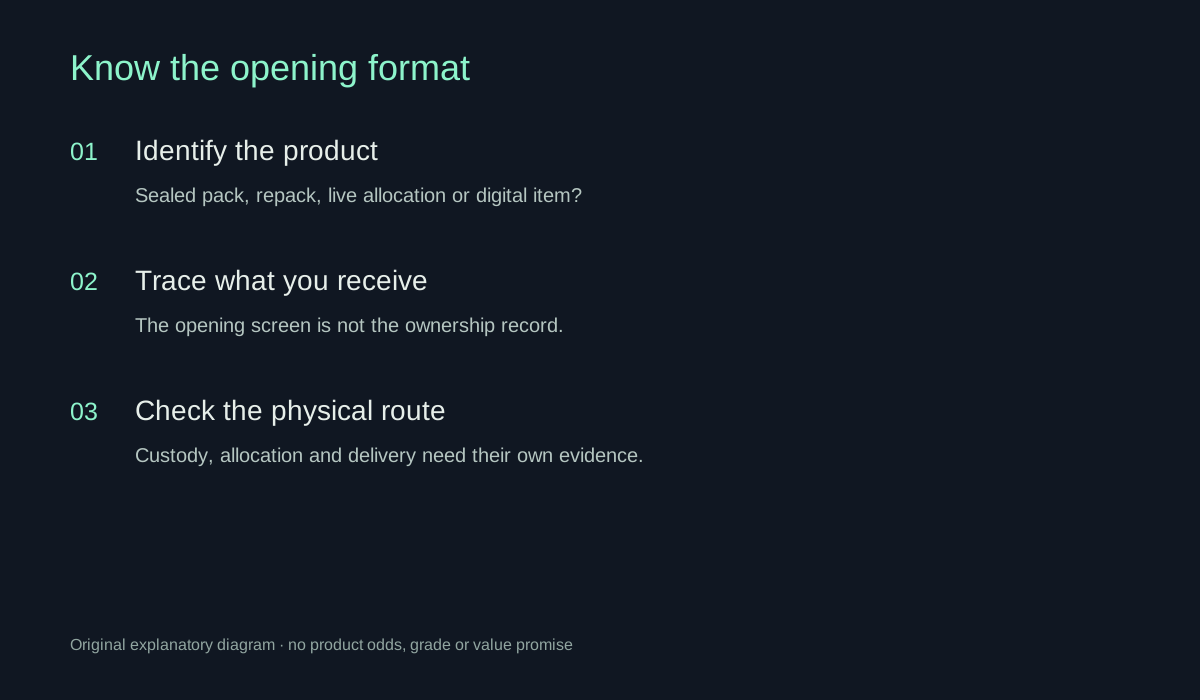
Compare the main formats
Fixed contents and random contents are useful starting points. For example, manufacturer product guidance distinguishes predetermined decks from randomized boosters. That distinction does not supply a universal pack size or guarantee a particular card.
Use the table below to read a listing. The final column identifies what you still need to check.
| Purchase | What you can identify beforehand | What remains uncertain | Check before paying |
|---|---|---|---|
| A single card | The card described in the listing | Whether the description, condition and delivered item match | Exact printing, photographs, condition and delivery terms |
| A fixed-content product | The stated contents for that exact product | Whether the correct product arrives in the stated condition | Published contents, edition and packaging |
| A manufacturer-sealed booster | The named product and its declared contents structure | The particular cards inside its random contents | Set, language, product version and any actual probability disclosure |
| A repack or mystery pack | Whatever the assembler discloses about the product | The item selection and any undisclosed allocation details | Who assembled it, what is promised and how selection is described |
| A live break spot | The participation or allocation described in the listing | Which opened cards, if any, match that allocation | Spot rules, treatment of unmatched cards and shipping conditions |
This is a comparison worksheet, not a set of universal sales terms. A product can combine features: an outer box may include a known promotional card alongside random boosters. Read each component separately.
A sealed pack and a repack have different origins
A manufacturer-sealed booster is a product supplied in its original packaging. A repack is assembled again from selected card products or cards. Published marketplace definitions distinguish sealed products from repackaged ones; their seller-admission rules apply to that marketplace, rather than to every repack on sale.
Packaging alone cannot answer which cards are possible, how they were selected or whether a displayed value is achievable in a sale. Read a claim such as “minimum value” alongside its definition: whose valuation is used, when it is assessed and which items or charges it includes.
Keep the exact product name and version in your notes. A description from a different release, language or package is not reliable evidence of what this purchase contains.
Follow the item beyond the reveal
For an opening arranged online, use this four-stage record:
| Stage | Evidence to keep | Question it should answer |
|---|---|---|
| Purchase | Listing, contents description and order confirmation | What did I agree to buy? |
| Allocation | Break rules and the record assigning an item to the purchase | Which item or cards have been assigned to me? |
| Holding | Any applicable storage or custody terms | Who holds the item, and under what conditions? |
| Delivery | Delivery agreement or shipment quote | How will I receive it, and what remains payable? |
Not every transaction includes storage or a separate delivery request. Mark a stage “not applicable” when you receive the physical product directly. Mark it “unanswered” when a seller has not explained it. Those entries mean different things.
Your location needs its own check. A website's language does not confirm that it accepts an order from your country or delivers to your address. A delivery statement also does not settle any separate participation restriction.
Work through the purchase description
A live-break spot needs an allocation explanation you can apply to an ordinary result. Imagine, purely as a teaching case, that a spot is described by a team name. Ask how the rules treat cards with several teams, items without a team and any cards outside the chosen category. These questions do not assert that every break uses the same rules. They show why a title and an opening broadcast are insufficient when the entitlement itself remains unclear.
A repack description needs its own source and date. Record who assembles it, the exact version being offered and which statements concern guaranteed inclusion rather than possible content. If the page highlights a desirable card without resolving whether that item belongs to the current offer, keep that uncertainty on the repack row. A manufacturer checklist for an original sealed release cannot answer what another party later selected for a repack.
Check that the saved description still matches
An updated product description needs its own dated record. Save the exact version, offer identifier and source used for the comparison, then check that the checkout still refers to that product. If a different version appears, pause and resolve the difference rather than carrying the first version’s checklist, contents or allocation assumptions into a new purchase. This is a record-checking step, not a claim that every page changes.
Conflicting descriptions should stay side by side until resolved. For example, if a fictional product summary and its allocation instructions seem to describe different entitlements, quote the conflicting wording in your question and ask which rule governs the actual offer. Retain the answer with the product record. Do not silently choose the interpretation that promises more cards, a better result or an easier physical handover.
Follow-up questions
Does every online reveal mean a physical card will be shipped?
A reveal does not establish shipment. Check the exact entitlement, physical item, custodian and delivery procedure separately.
What should I ask if a break or repack description is unclear?
Ask for the rule covering the unclear allocation, and save the product version and date. Another product’s checklist cannot supply the missing answer.
Match the format to your goal
If you want a particular card, an identified single lets you assess that item before buying. If opening is part of the experience you want, decide how much you are prepared to spend without obtaining a particular result. Neither choice settles authenticity, condition or delivery by itself.
Use the singles-versus-packs decision worksheet to separate the collecting goal from the opening experience.
Before choosing, write down five answers:
- What exactly am I buying?
- Which contents or allocation rules are disclosed?
- What physical item, if any, is promised to me?
- Which charges remain outside the displayed price?
- What spending limit have I chosen before opening?
An unanswered question is a reason to obtain the missing information or wait. You do not need to make a purchase to complete the worksheet.
Sources and evidence limits
Primary documentation checked on the dates below. A source check is not firsthand collecting, authentication, grading or transaction testing.
- support.pokemon.com: manufacturer product guidanceChecked 2026-11-14 · Exact documentation cited in the collector guide; bounded by its surrounding text.
Documentation research, not firsthand purchase/grading/authentication testing. No general odds or availability inferred.
- stockx.com: Published marketplace definitionsChecked 2026-11-14 · Exact documentation cited in the collector guide; bounded by its surrounding text.
Documentation research, not firsthand purchase/grading/authentication testing. No general odds or availability inferred.
- pages.ebay.com: one marketplace's break guidanceChecked 2026-11-14 · Exact documentation cited in the collector guide; bounded by its surrounding text.
Documentation research, not firsthand purchase/grading/authentication testing. No general odds or availability inferred.