
Separate the cost categories
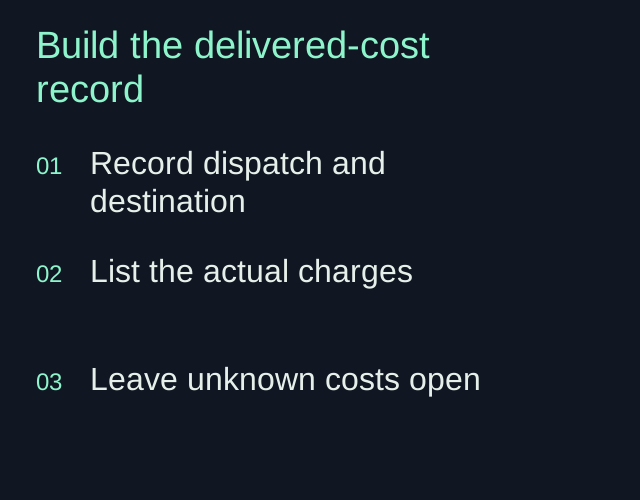
Begin with the actual item, its dispatch location and your destination. Then distinguish charges collected by the operator from charges that can arise later. Retrieval or handling, delivery service, insurance options, taxes and carrier administration may be described in different places. A single prominently advertised shipping price may not answer all of those questions.
| Cost question | What to record |
|---|---|
| Operator charges | Retrieval/handling and the current shipment quote. |
| Destination charges | Applicable import/VAT/customs questions for your country and transaction. |
| Carrier charges | Any separately explained clearance or administration charge. |
| Currency | The charge currency and your payment provider’s conversion terms. |
This guide does not calculate a tariff, exemption or tax rate. Classification and charges depend on the actual circumstances and current rules; do not borrow a number from another country or an old parcel.
Find where the physical card will leave from
A platform’s audience, company address and card storage location are different facts. International shipping questions depend on the actual movement of the physical item. Read the redemption instructions and ask where the item will be dispatched from when that is not clear. A European website address does not prove an EU dispatch location.
Use the European Commission’s customs guidance as a starting point, then the customs authority for your destination. Check what documentation and declared information are required for this transaction. Never ask a sender to misdescribe an item or its value to avoid charges.
Compare the practical delivery options
Read the current quote for your address and the service you intend to use. Ask whether multiple cards can travel together, how tracking is provided, which delivery or signature conditions apply and what happens if the parcel cannot be delivered. Treat an advertised estimate as an estimate, not a guaranteed arrival date.
- Check the exact address rather than a regional marketing statement.
- Find which quote components are included and which are excluded.
- Read the loss/damage reporting process and evidence required.
- Check storage, failed delivery and return conditions if relevant.
- Keep enough budget for unresolved charges instead of spending it on another opening.
Keep a shipment record
Record the dispatch origin, actual destination, item identifier, quoted transport charge and any separately stated tax or handling amount. Save the source and date, and mark unanswered costs rather than filling them with an assumed universal rate.
Do not rely on another customer’s successful parcel as proof for your case. Their country, product, service, verification state or date may differ. A screenshot of a low quote can be genuine and still be irrelevant to the shipment you are considering.
Prepare for delivery, not just dispatch
Retain your item record, quote, request confirmation and tracking details. Read the operator’s reporting process before a problem occurs. If a parcel arrives damaged or incomplete, document its condition and preserve the packaging while following the responsible operator or carrier’s instructions. RipsFinder cannot handle the claim or release the collectible.
If the full delivery path makes an opening unsuitable for your budget or purpose, stop before buying. Leaving a card in custody can be a deliberate choice, but it should not be an accidental consequence of discovering costs too late. Read custody rules and any ongoing conditions as well as the delivery quote.
Sources and evidence limits
Primary documentation checked on the dates below. A source check is not firsthand collecting, authentication, grading or transaction testing.
- European Commission, Taxation and Customs Union: Buying goods online from a non-EU countryChecked 2026-11-14 · Official starting point for import procedures and destination-country charge checks.
No card tariff code, threshold or rate is calculated here; consult the current customs authority for the actual destination and transaction.