
Start with the question
This order helps when two cards show the same Pokémon but have different artwork, foil treatments or numbers. It also stops a printed rarity symbol from being confused with a condition grade or a price.
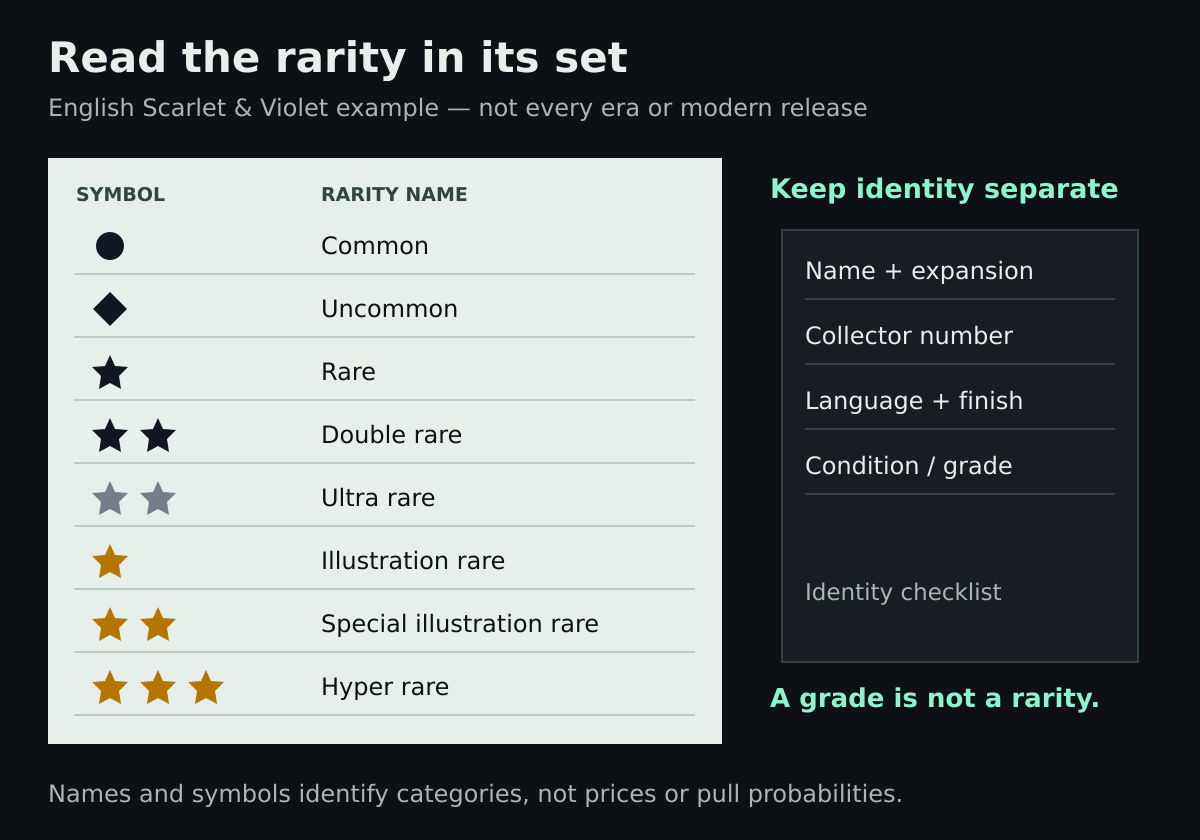
Start with an exact identity record
Copy these details before searching for a value or another copy:
| Detail | What to record |
|---|---|
| Card name | The complete printed name, including any suffix |
| Expansion | Set name and printed expansion code or symbol |
| Collector number | The exact number as printed, including any prefix or denominator |
| Language | The card's actual printed language |
| Finish and variant | The documented foil treatment or other version |
| Condition | Visible wear, or the grading provider and exact grade if encapsulated |
A name alone is often insufficient. The official English Scarlet & Violet checklist, for example, lists Miraidon ex at numbers 081, 227, 244 and 253. Those are distinct entries to check, rather than interchangeable results for the same search.
Photograph the front and back of a card you own, including its identifying details. A readable picture is useful evidence for matching a record; it does not, by itself, authenticate the physical card.
Read a rarity legend for the correct era
The table below is a scoped English Scarlet & Violet example, checked against the official checklist and an illustrated symbol reference. It is not an exhaustive list for every modern Pokémon expansion, language or historical set.
| Symbol description | Rarity name in this example |
|---|---|
| Black circle | Common |
| Black diamond | Uncommon |
| One black star | Rare |
| Two black stars | Double rare |
| Two silver stars | Ultra rare |
| One gold star | Illustration rare |
| Two gold stars | Special illustration rare |
| Three gold stars | Hyper rare |
Shape, colour and count matter. So does the set: do not take the description for a different printing and apply it because a symbol looks similar. Keep the text label beside a symbol when making your own collection notes.
These names classify cards. They do not tell you a card's current price, total surviving population or chance of appearing in a particular product.
Modern cards do not use one unchanging system
New releases can add categories and treatments. The official January 2026 Ascended Heroes announcement, for example, identifies Mega attack rare as a new rarity. An older Scarlet & Violet chart cannot be a complete reference for that later release.
Use the exact official checklist or card record when the terminology differs. Collector descriptions such as “alt art” can be useful search clues, but record the official classification and exact version as well.
The same care applies to vintage cards. A modern label, finish or symbol convention should not be assumed to describe an older printing.
Keep finish, rarity and condition separate
A foil treatment describes a printing feature. A rarity classification describes a category within the relevant release. A condition description concerns the state of the particular physical copy.
Keep all three fields. A card with wear still has its original printed identity; the wear belongs in its condition record. Conversely, a high condition grade does not change the printed rarity.
When comparing a regular and a reverse-foil version, confirm that the exact set documents both. Do not assume a familiar name means the same finish is available in every language or release. Nor should you assume a shinier version must always be scarcer or more valuable.
Find where a card is documented
Use this short research path before looking for products:
- Identify the expansion and language. Use the card's printed details, rather than packaging artwork alone.
- Find the official checklist or card record. Match the full name and number, then check the listed version.
- Read any separate product notes. A promo or special product may have its own documented distribution.
- Save the source and date. Record what the document establishes and what remains unanswered.
The Ascended Heroes announcement illustrates why product notes matter: it lists named promo cards with particular collections. That is different from assuming a pictured card can be pulled from any booster bearing the expansion's name.
A checklist establishes that a card is listed in that set. A product note can establish a stated inclusion or distribution route. Neither automatically supplies a pull probability, confirms current EU stock or describes the contents of a third-party repack.
A grading label answers another question
If a card is in a graded holder, record the provider, grade, category and certificate reference separately from the card's set and rarity. A “10” is a grading result under that provider's system, not a Pokémon rarity.
Check the corresponding certificate record and compare the identity details. Matching a number alone is not proof that an unfamiliar physical holder is genuine. For an ungraded card, retain photographs and a clear description rather than assigning it a professional grade yourself.
A little context on exceptional cards
Vintage, promotional and trophy-related cards can have a distribution history very different from modern booster cards. An exceptional sale is also specific to its item and circumstances. The documented 2026 Illustrator auction lot included additional objects alongside the graded card. Its lot result should not become a value for every Illustrator copy, a current record claim or an expectation for an ordinary opening.
For your own collection, exact identity, condition and comparable evidence remain more useful than a headline price.
Work through a card match before comparing rarity
A wanted card and an offered card must match the identity you actually chose. Suppose your collection notes refer to entry 081, while an offered listing identifies entry 227. That is a mismatch to resolve, even before condition or price enters the decision. Ask whether you want that different entry; do not describe it as an equivalent replacement merely because both records contain the words Miraidon ex. The checklist establishes distinct entries, not which purchase is right for you.
A collection record should keep uncertainty visible rather than turn it into a rarity claim. If a photograph makes the finish unclear, write “finish not confirmed”. If the language or number cannot be read, request a clearer record before making the comparison. A seller description can be a starting clue, but it should not silently replace the printed identity. This approach is useful whether you are sorting cards already owned or making a short wanted list. Label the front and back photographs with the same item record. That simple check prevents a comparison from accidentally pairing two readable images that have not been shown to depict the same copy.
Follow-up questions
Does printed rarity establish a selling price?
Printed rarity is a release classification, not a selling price. Match identity and condition before examining comparable evidence.
Which legend should I use for another language or release?
Use the exact release and language record. The English Scarlet & Violet table is scoped; another printing may need a different reference.
Make one useful collection entry
| Your record | Fill in |
|---|---|
| Exact card | Name, expansion, number and language |
| Classification | Set-specific rarity and documented finish |
| Evidence | Official source link and date checked |
| Physical copy | Photographs, condition or provider/grade/certificate |
| Still unknown | A variant, source detail or condition question needing confirmation |
Start with one card you already own. Once its identity is clear, the singles-versus-packs worksheet can help you choose between obtaining another identified card and paying for an opening experience.
Sources and evidence limits
Primary documentation checked on the dates below. A source check is not firsthand collecting, authentication, grading or transaction testing.
- assets.pokemon.com: official English Scarlet & Violet checklistChecked 2026-11-14 · Exact documentation cited in the collector guide; bounded by its surrounding text.
Documentation research, not firsthand purchase/grading/authentication testing. No general odds or availability inferred.
- www.cgcgrading.com: illustrated symbol referenceChecked 2026-11-14 · Exact documentation cited in the collector guide; bounded by its surrounding text.
Documentation research, not firsthand purchase/grading/authentication testing. No general odds or availability inferred.
- press.pokemon.com: official January 2026 Ascended Heroes announcementChecked 2026-11-14 · Exact documentation cited in the collector guide; bounded by its surrounding text.
Documentation research, not firsthand purchase/grading/authentication testing. No general odds or availability inferred.
- goldin.co: 2026 Illustrator auction lotChecked 2026-11-14 · Exact documentation cited in the collector guide; bounded by its surrounding text.
Documentation research, not firsthand purchase/grading/authentication testing. No general odds or availability inferred.